Empowering students to reach their mathematical potential through traditional and fun teaching methods.
Monday, December 8, 2025
Thursday, December 4, 2025
Comparing and Ordering Fractions
Topics for Today:
When comparing any two numbers, we must have them in a format that can be compared. For fractions this means that we must have a common denominator to determine which part of a whole is greater than the other.We discussed symbols of comparison today to include
- greater than (>)
- less than (<)
- equal to (=)
- not equal to (≠)
Vocabulary:
least common denominator, LCDSections Covered in Textbook:
3-6: Comparing and Ordering Fractions (pages 156-159)
Resources & Tutorials:
1) How do you put fractions in order using an LCD?Simplifying Fractions
Topics for Today:
Today we discussed equivalent fractions. Equivalent fractions are different names for the same amount. We also used prime factorization to simplify fractions. Fractions that are in simplest form do not have any common factors in the numerator and denominator except for the number 1.Vocabulary:
equivalent fractions, simplest formSections Covered in Textbook:
3-5: Simplifying Fractions (pages 151-155)
Resources & Tutorials:
1) Simplifying Fractions (Math Antics)Friday, November 14, 2025
Prime Factorization
Topics for Today:
Today we discussed prime numbers and prime factorization. A prime number is a number that has exactly two factors: one and itself. We used our divisibility rules from yesterday to help us break numbers down into their prime factors in preparation for simplifying fractions as well as finding common denominators. Prime factorization is a technique that can be used for many mathematical purposes. We also completed the Sieve of Eratosthenes to help us identify all the prime numbers between 1 and 100.Vocabulary:
prime factorization, prime number, composite number, Least Common Multiple, LCM,
Greatest Common Factor, GCF, multiple
Sections Covered in Textbook:
3-4: Prime Factorization
Resources & Tutorials:
Sunday, November 9, 2025
Divisibility Rules
Topics for Today:
Today we discussed the rules for divisibility. A number is divisible by another if it can be divided by it with no remainder. Knowing divisibility rules helps with simplifying fractions and prime factorization.Vocabulary:
divisibleSections Covered in Textbook:
3-3: Divisibility Tests (pages 141-144)
Resources & Tutorials:
1) What does divisibility mean?
Extras:
Thursday, September 4, 2025
Dividing Decimals
Topics for Today:
Today we reviewed how to divide decimals.The MAIN IDEA is that the divisor (the number we divide by) must be a whole number. To make a decimal whole, we must multiply the divisor AND the dividend (the number we divide into) by the same factor of 10.
Vocabulary:
divisor, dividend, quotientSections Covered in Textbook:
1-3: Multiplying and Dividing Decimals (pages 17-22)
Resources & Tutorials:
1) How do you divide decimals?****Join Delta Math Class (click here)****
First Delta Math Review Assignment due Friday
Tuesday, September 2, 2025
Multiplying Decimals
Topics for Today:
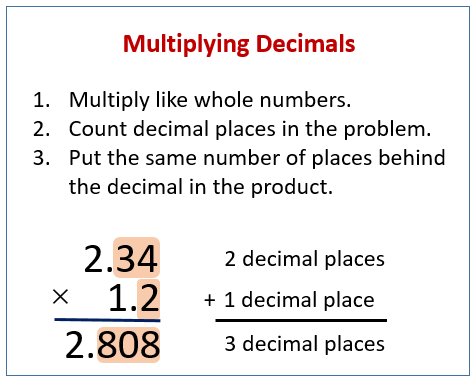
Multiplication and division of decimals were the topics for today. We also discussed some of the properties of multiplication. The properties of equality are a set of rules that allow us to perform operations on equations without changing the truth of the equation.Main Ideas:

Vocabulary:
identity property of equality, zero property, commutative property of multiplication, associative property of multiplicationSections Covered in Textbook:
1-3: Multiplying and Dividing Decimals (pages 17-22)
Resources & Tutorials:
1) How do you multiply decimals?Tuesday, August 26, 2025
Adding and Subtracting Decimals
Topics for Today:
We are getting back into the swing of things, and setting up classroom routines. Today we did a bit of review of adding and subtracting decimals.**Adding/Subtracting Decimal Numbers MAIN IDEA***
--> When adding or subtracting decimals, always line up the decimal points!
We also did a brief review of subtracting decimals using regrouping, as well as bringing in zeroes (called annexing) to make sure our numbers line up. We also discussed a few of the properties of equality.
Vocabulary:
identity property of addition, commutative property of addition, associative property of additionSections Covered in Textbook:
1-2: Adding and Subtracting Decimals (pages 11-15)
Resources & Tutorials:
1) How do you add decimals?2) How do you subtract decimals?
Friday, August 22, 2025
Estimation Strategies
Topics for Today:
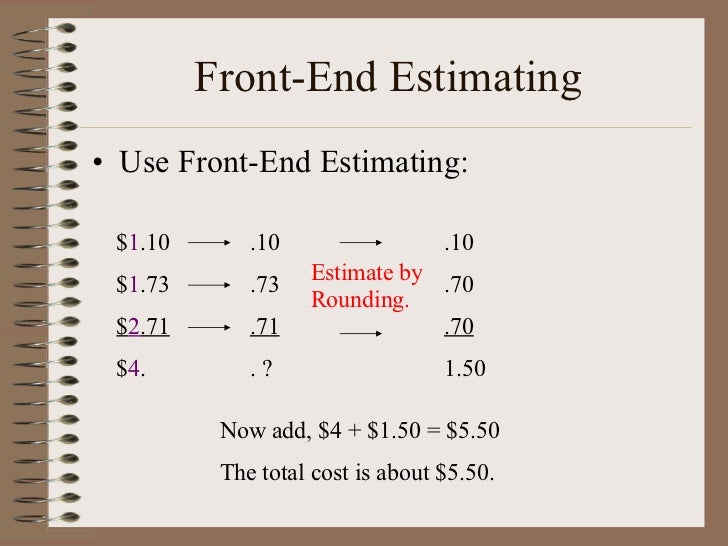
Today we discussed some strategies for estimating the answers to numeric expressions. Students were asked to consider both how to estimate as well as the reasons why we use estimation. We will spend a lot of discussion time this school year on number sense, and determining if our solutions to problems make sense.
Vocabulary:
Sections Covered in Textbook:
1-1: Using Estimation Strategies (pages 5 - 9)
Resources & Tutorials:
1) How do you use front-end estimation to estimate a sum of several decimals?2) How do you estimate a quotient using compatible numbers?
1) Guess It! - Online Estimation Game
Subscribe to:
Comments (Atom)