Thursday, September 30, 2021

The Distributive Property

Topics for Today:

Today we explored a the distributive property of multiplication over addition and subtraction.  Previously, we learned to perform operations according to a set of rules called The Order of Operations, and students refer to this concept at PEMDAS (pronounced pem-das).  When we have multiplication of a number by a quantity, we may also use the distributive property to solve.  When we progress to pre-algebra and solving equations, we will have to use this property to remove parentheses so that we may solve for our unknown.  Today, we used the property to rewrite multiplication problems to make them easier to solve.  


Vocabulary:

distributive property

Sections Covered in Textbook:

1-9: Order of Operations and the Distributive Property (pages 50-55)


Resources & Tutorials:

1) How do you distribute a number into an addition problem to solve?

Thursday, September 23, 2021

Order of Operations

Topics for Today:

As with any language, math has some basic rules that must be followed to arrive at a correct answer. Sometimes there are multiple ways to express an answer or number so we need a set of rules to follow so we always arrive at the same answer for any one particular problem. The order of operations is a set of rules that tells problem solvers which operations to perform and in what order.

Vocabulary:

order of operations, PEMDAS

Sections Covered in Textbook:

1-9: Order of Operations and the Distributive Property (pages 50-55)


Resources & Tutorials:

1) What is the order of operations?
2) How do you use the order of operations?
3) Class Notes - Exponents and Order of Operations


Assignments:

1) Order of Operations Worksheet

Wednesday, September 22, 2021

Multiplying and Dividing Integers

Topics for Today:

We moved on to multiplying and dividing integers today.

Some basic sign rules for multiplication and division:

+ · + = +      + / + = +

+ · - = -      + / - = -

- · + = -      - / + = -

- · - = +      - / - = +

Stated a different way, when we multiply two integers with the same sign, we get a positive product; when we multiply two integers with different signs, we get a negative.  The same rules apply for division.  Many students find multiplying and dividing integers to be much easier than adding and subtracting!

Vocabulary:


Sections Covered in Textbook:

1-8: Multiplying and Dividing Integers (pages 45-49)


Resources & Tutorials:

1) How do you multiply and divide numbers with different signs?
2) What are Multiplicative Inverses?
3) What is a reciprocal?
4) Multiplying and Dividing Integers Class Notes


Monday, September 20, 2021

Adding & Subtracting Integers - One More Day

Topics for Today:

Today we worked on adding and subtracting integers for one more day.  The biggest improvement I see with students' mastery comes when they realize that subtraction is related to addition, and that if they add the opposite (rewrite the problem!) it becomes so much easier. 


Sections Covered in Textbook:

No new material was covered today


Resources & Tutorials:

See tutorials from the past 2 blog entries


Friday, September 17, 2021

Subtracting Integers

Topics for Today:

Subtracting integers can be a tricky concept for our younger students, especially those still developing abstract thinking skills.  We used two concrete methods today to discuss subtraction of integers.  The first important key is to realize that subtraction means to physically take something away.  It can be challenging to understand how to take something away that isn't there to begin with.  To accomplish subtraction, we used integer chips and number lines to illustrate how subtraction works.  

For the purpose of this illustration, an orange chip is positive 1 and a red chip is negative 1.  Together, the two add to zero (additive inverse property).  


We then discussed the definition of subtraction as the addition of opposites.  We can change any subtraction problem into addition if we add the opposite.

TO SUBTRACT, ADD THE OPPOSITE!


Vocabulary:

rule for subtracting integers, subtraction

Sections Covered in Textbook:

1-7:  Adding and Subtracting Integers (pages 39-44)


Resources & Tutorials:


1) How do you add two negative numbers?
2) Rules for Adding Integers
3) How to rewrite a subtraction problem as addition
4) Subtracting Integers Class Notes


Wednesday, September 15, 2021

Adding Integers

Topics for Today:

We used integer chip models and rules to add integers today. We talked about the inverse property of addition and discovered that additive inverses are just opposites of each other, and they add to zero. We also discussed how to use a number line to represent addition problems of both positive and negative integers.


Vocabulary:

additive inverse, inverse property of addition

Sections Covered in Textbook:

1-7: Adding and Subtracting Integers - Part 1 (pages 39-44)


Resources & Tutorials:

1) How do you add two negative numbers?
2) Rules for Adding Integers
3) What is the opposite of a number?
4) Adding Integers class notes


Monday, September 13, 2021

Summary of Decimal Operations

Topics for Today:

Today we reviewed all the decimal operations and organized our notes using a foldable.  There are a few things we need to remember when performing operations on Decimals:


Vocabulary:

No new material covered.

Sections Covered in Textbook:

No new material covered.

Thursday, September 9, 2021

Comparing and Ordering Integers

Topics for Today:

Absolute value is an important mathematical concept that is applied in many areas.  Absolute value is a number's distance from zero.  Because we are looking at a distance, we are only concerned about positive values.  Absolute value is always positive!

We discussed integers today and also defined what number opposites are (additive inverses).  Using a number line, we also compared the size of numbers using inequality symbols and analyzed integers to put in the in order from least to greatest.


Vocabulary:

opposites, integers, absolute value


Sections Covered in Textbook:

1-6: Comparing and Ordering Integers (pages 34-38)


Resources & Tutorials:

1) What is an integer?
2) What does absolute value mean?

Wednesday, September 8, 2021

Dividing Decimals

Topics for Today:

Today we reviewed how to divide decimals.  

The MAIN IDEA is that the divisor (the number we divide by) must be a whole number.  To make a decimal whole, we must multiply the divisor AND the dividend (the number we divide into) by the same factor of 10.  


Vocabulary:

divisor, dividend, quotient

Sections Covered in Textbook:

1-3: Multiplying and Dividing Decimals (pages 17-22)


Resources & Tutorials:

1) How do you divide decimals?

****Join Delta Math Class (click here)****
First Delta Math Review Assignment due Friday

Extras:

Decimals Board Game (online game)

Wednesday, September 1, 2021

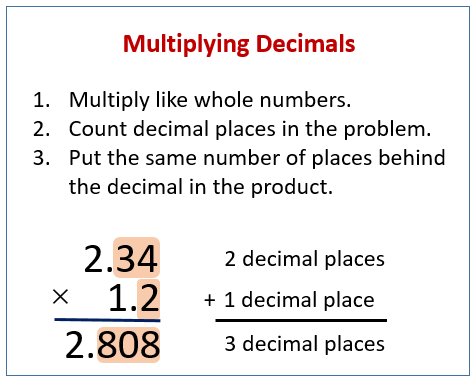
Multiplying Decimals

Topics for Today:

Multiplication and division of decimals were the topics for today.  We also discussed some of the properties of multiplication.  The properties of equality are a set of rules that allow us to perform operations on equations without changing the truth of the equation.

Main Ideas:

Multiplying Decimals


Vocabulary:

identity property of equality, zero property, commutative property of multiplication, associative property of multiplication


Sections Covered in Textbook:

1-3: Multiplying and Dividing Decimals (pages 17-22)


Resources & Tutorials:

1) How do you multiply decimals?