Empowering students to reach their mathematical potential through traditional and fun teaching methods.
Monday, December 13, 2021
Friday, December 10, 2021
Unit Rates
Topics for Today:
Unit rates are useful for comparing different sizes of various items. Today we defined a rate as a comparison of two quantities that have different units. In science, we measure speed, which is a rate that compares distance traveled over a certain amount of time. To find our rate, we divide distance (length measurement) by time.Vocabulary:
ratio, rate, unit rateSections Covered in Textbook:
5-2: Unit Rates (pages 246-250)
Resources & Tutorials:
1) What are rates and unit rates?Thursday, December 9, 2021
Ratios
Topics for Today:
Vocabulary:
ratioSections Covered in Textbook:
5-1: Ratios (pages 241-245)
Resources & Tutorials:
1) What is a ratio?Monday, December 6, 2021
Unit 3 Review Day
Topics for Today:
Today we revisited precision and how to round to the proper place when assigning the correct level of precision to our answers.- Measurement conversion in the Customary System
- Precision
- Adding and Subtracting Fractions and Mixed Numbers
- Multiplying and Dividing Fractions and Mixed Numbers
- Estimating and Rounding Fractions
Vocabulary:
noneResources & Tutorials:
Students needing help should revisit all blog entries for Unit 3.Friday, December 3, 2021
Precision
Topics for Today:
Today we talked about precision in measurements. Precision is the degree of exactness we can achieve when measuring something. The smaller the unit of measurement we use, the more precise our measurement will be. When we are combining (adding or subtracting) measurements, we can only report our answer using the precision of our least precise measurement.Vocabulary:
precisionSections Covered in Textbook:
4-9: Precision (pages 227-230)Thursday, December 2, 2021
Changing Units in the Customary System
Topics for Today:
Today we discussed units of measurement in the customary system, and the various equivalent units. We also used equivalent measurements to convert between measurements.Vocabulary:
customary systemSections Covered in Textbook:
4-8: Changing Units in the Customary System (pages 222-226)
Resources & Tutorials:
1) What are the customary units of length?Monday, November 29, 2021
Revisiting Fraction Operations
Topics for Today:
Welcome back! Hopefully everyone had a relaxing and fun break.Sections Covered in Textbook:
No new material was covered today - we spent time reviewing instead.
Resources & Tutorials:
If they need help, students should revisit blog entries from November 10th through 15th. Monday, November 15, 2021
Dividing Fractions and Mixed Numbers
Topics for Today:
- We don’t really “divide” fractions – we multiply by the inverse also known as the reciprocal.
- Just like with multiplication, mixed numbers must be converted to improper fractions before we may begin.
- Once we rewrite the problem as multiplication, we then just follow the rules of multiplying fractions.
- When multiplying fractions . . .We take out common factors in the numerator and denominator,
- Next, we multiply numerators, and then
- We multiply denominators.
- Final answers should always be in simplest form.
- Some remember the process as KEEP --- CHANGE --- FLIP
Vocabulary:
reciprocalSections Covered in Textbook:
4-5: Dividing Fractions and Mixed Numbers (pages 207-212)
Resources & Tutorials:
1)What is the reciprocal rule of dividing fractions?
Friday, November 12, 2021
Multiplying Fractions and Mixed Numbers
Topics for Today:
We are moving right along with fraction operations. Today we discussed multiplying fractions and mixed numbers. There is no need for a common denominator when multiplying. We do have to convert any mixed numbers to improper fractions before we can perform the multiplication. Because multiplying numbers can make our answers get very big, very fast, we first want to divide out common factors in the numerator and denominator before we multiply.Vocabulary:
multiply fractionsSections Covered in Textbook:
4-4: Multiplying Fractions and Mixed Numbers
Resources & Tutorials:
1) How do you multiply fractions?Thursday, November 11, 2021
Adding and Subtracting Mixed Numbers
Topics for Today:
Adding and subtracting mixed numbers was our topic of today. To add or subtract mixed numbers, we must still have a common denominator for the fractional component. There are times when we must regroup after adding or before subtracting, depending upon our problem.Sections Covered in Textbook:
4-3: Adding and Subtracting Mixed Numbers (pages 197-201)
Resources & Tutorials:
1) How do you add mixed fractions with the same denominator?Wednesday, November 10, 2021
Adding and Subtracting Fractions
Topics for Today:
Today we began working on operations with fractions by adding and subtracting.Vocabulary:
Sections Covered in Textbook:
4-2: Adding and Subtracting Fractions (pages 192-196)
Resources & Tutorials:
1) How do you find a common denominator and a least common denominator?Monday, November 8, 2021
Estimating with Fractions and Mixed Numbers
Topics for Today:
Today we discussed estimating operations with fractions in preparation for doing the actual arithmetic in the lessons that will follow. We used benchmarks (values used as reference points) to help determine how to round fractional pieces to find our estimates. We used number sense to figure out when to round fractions up or down based upon their closeness to the fraction of 1/2. We also revisited the concept of compatible numbers to help with estimating division problems.Vocabulary:
benchmarkSections Covered in Textbook:
4-1: Estimating with Fractions and Mixed Numbers (pages 187-190)
Resources & Tutorials:
1) Estimating Mixed NumbersThursday, November 4, 2021
Unit 2 Review - Day 2
Topics for Today:
Today we played a game of Money Grab to finish up our review of Unit 2. Students should make sure their notebooks are fully organized prior to joining class on Friday. Notebooks will be collected at the beginning of class, and no class time on test day will be allocated for organizing - this task needs to be completed prior to coming to class on Friday.Resources & Tutorials:
Money Grab Questions and AnswersWednesday, November 3, 2021
Unit 2 Review
Topics for Today:
Today we played we spent time working on our notebooks and reviewing for our Unit 2 Test on Friday. We will continue our review tomorrow. Students can find the table of contents for any unit on the Table of Contents Page of this blog.Vocabulary:
See page 178 in your textbookSections Covered in Textbook:
Chapter 3 Sections 3-3 through 3-10 (skip 3-7) - Pages 141-179
Resources & Tutorials:
Unit 2 Review SheetMonday, November 1, 2021
Rational Numbers
Topics for Today:
You have seen rational numbers your entire life, but have referred to them as fractions. The word "rational" contains the word "ratio", which is just a comparison of numbers by division. In our lesson on Friday, we discussed that a fraction is really a division problem with the vinculum (fraction bar) serving as a division symbol.Vocabulary:
rational numberSections Covered in Textbook:
3-10: Rational Numbers (pages 173-176)
Resources & Tutorials:
1) What is a rational number?Friday, October 29, 2021
Fractions and Decimals
Topics for Today:
Today we talked about converting fractions to decimals and vice versa. A fraction is simply a division problem with the denominator serving as the divisor. Any fraction can be converted to a decimal by dividing the denominator into the numerator.Vocabulary:
terminating decimal, repeating decimalSections Covered in Textbook:
3-9: Fractions and Decimals (pages 168-172)
Resources & Tutorials:
1) Convert a fraction to a decimalThursday, October 28, 2021
Mixed Numbers and Improper Fractions
Topics for Today:
Fractions that have numerators that are as big as or larger than their denominators are called improper fractions. We can covert between mixed numbers and improper fractions by using multiplication and division.Vocabulary:
improper fraction, mixed numberSections Covered in Textbook:
3-8: Mixed Numbers and Improper Fractions (pages 164-167)
Resources & Tutorials:
1) What is a mixed number?Monday, October 25, 2021
Comparing and Ordering Fractions
Topics for Today:
When comparing any two numbers, we must have them in a format that can be compared. For fractions this means that we must have a common denominator to determine which part of a whole is greater than the other.- greater than (>)
- less than (<)
- equal to (=)
- not equal to (≠)
Vocabulary:
least common denominator, LCDSections Covered in Textbook:
3-6: Comparing and Ordering Fractions (pages 156-159)
Resources & Tutorials:
1) How do you put fractions in order using an LCD?Friday, October 22, 2021
Simplifying Fractions
Topics for Today:
Today we discussed equivalent fractions. Equivalent fractions are different names for the same amount. We also used prime factorization to simplify fractions. Fractions that are in simplest form do not have any common factors in the numerator and denominator except for the number 1.Vocabulary:
equivalent fractions, simplest formSections Covered in Textbook:
3-5: Simplifying Fractions (pages 151-155)
Resources & Tutorials:
1) Simplifying Fractions (Math Antics)Wednesday, October 20, 2021
Prime Factorization
Topics for Today:
Today we discussed prime numbers and prime factorization. A prime number is a number that has exactly two factors: one and itself. We used our divisibility rules from yesterday to help us break numbers down into their prime factors in preparation for simplifying fractions as well as finding common denominators. Prime factorization is a technique that can be used for many mathematical purposes. We also completed the Sieve of Eratosthenes to help us identify all the prime numbers between 1 and 100.Vocabulary:
Sections Covered in Textbook:
3-4: Prime Factorization
Resources & Tutorials:
Monday, October 18, 2021
Divisibility Rules
Topics for Today:
Today we discussed the rules for divisibility. A number is divisible by another if it can be divided by it with no remainder. Knowing divisibility rules helps with simplifying fractions and prime factorization.Vocabulary:
divisibleSections Covered in Textbook:
3-3: Divisibility Tests (pages 141-144)
Resources & Tutorials:
1) What does divisibility mean?Friday, October 1, 2021
Guess, Check, and Revise Strategy
Topics for Today:
Today we explored some story problems. Students typically are not excited about story problems until they see and solve enough of them to start recognizing patterns. One of the main focuses of the mathematics program at Field School is to help students organize problems and apply them to patterns we have worked with together.Today we used the guess, check, and revise strategy which is very useful especially for students who have not had a thorough Algebra I course. For this strategy, students take the information from the problem and try combinations until they satisfy the other conditions in a problem. Organizing the guesses into a table keeps the work organized.
Vocabulary:
guess, check, and reviseSections Covered in Textbook:
None - this lesson was pulled from other materials
Resources & Tutorials:
1) How to solve an equation by guessing and checking.2) Learn Guess and Check (not a video).
Thursday, September 30, 2021
The Distributive Property
Topics for Today:
Today we explored a the distributive property of multiplication over addition and subtraction. Previously, we learned to perform operations according to a set of rules called The Order of Operations, and students refer to this concept at PEMDAS (pronounced pem-das). When we have multiplication of a number by a quantity, we may also use the distributive property to solve. When we progress to pre-algebra and solving equations, we will have to use this property to remove parentheses so that we may solve for our unknown. Today, we used the property to rewrite multiplication problems to make them easier to solve.Vocabulary:
distributive propertySections Covered in Textbook:
1-9: Order of Operations and the Distributive Property (pages 50-55)
Resources & Tutorials:
1) How do you distribute a number into an addition problem to solve?Thursday, September 23, 2021
Order of Operations
Topics for Today:
As with any language, math has some basic rules that must be followed to arrive at a correct answer. Sometimes there are multiple ways to express an answer or number so we need a set of rules to follow so we always arrive at the same answer for any one particular problem. The order of operations is a set of rules that tells problem solvers which operations to perform and in what order.Vocabulary:
order of operations, PEMDASSections Covered in Textbook:
1-9: Order of Operations and the Distributive Property (pages 50-55)
Resources & Tutorials:
1) What is the order of operations?2) How do you use the order of operations?
3) Class Notes - Exponents and Order of Operations
Assignments:
1) Order of Operations WorksheetWednesday, September 22, 2021
Multiplying and Dividing Integers
Topics for Today:
We moved on to multiplying and dividing integers today.
Some basic sign rules for multiplication and division:
+ · + = + + / + = +
+ · - = - + /
- = -
- · + = - - /
+ = -
- · - = + - /
- = +
Stated a different way, when we multiply two integers with the same sign, we get a positive product; when we multiply two integers with different signs, we get a negative. The same rules apply for division. Many students find multiplying and dividing integers to be much easier than adding and subtracting!
Vocabulary:
Sections Covered in Textbook:
1-8: Multiplying and Dividing Integers (pages 45-49)
Resources & Tutorials:
1) How do you multiply and divide numbers with different signs?
2) What are Multiplicative Inverses?
3) What is a reciprocal?
4) Multiplying and Dividing Integers Class Notes
Monday, September 20, 2021
Adding & Subtracting Integers - One More Day
Topics for Today:
Today we worked on adding and subtracting integers for one more day. The biggest improvement I see with students' mastery comes when they realize that subtraction is related to addition, and that if they add the opposite (rewrite the problem!) it becomes so much easier.Friday, September 17, 2021
Subtracting Integers
Topics for Today:
Subtracting integers can be a tricky concept for our younger students, especially those still developing abstract thinking skills. We used two concrete methods today to discuss subtraction of integers. The first important key is to realize that subtraction means to physically take something away. It can be challenging to understand how to take something away that isn't there to begin with. To accomplish subtraction, we used integer chips and number lines to illustrate how subtraction works.Vocabulary:
rule for subtracting integers, subtractionSections Covered in Textbook:
1-7: Adding and Subtracting Integers (pages 39-44)
Resources & Tutorials:
1) How do you add two negative numbers?
2) Rules for Adding Integers
3) How to rewrite a subtraction problem as addition
4) Subtracting Integers Class Notes
Wednesday, September 15, 2021
Adding Integers
Topics for Today:
We used integer chip models and rules to add integers today. We talked about the inverse property of addition and discovered that additive inverses are just opposites of each other, and they add to zero. We also discussed how to use a number line to represent addition problems of both positive and negative integers.Sections Covered in Textbook:
1-7: Adding and Subtracting Integers - Part 1 (pages 39-44)
Resources & Tutorials:
1) How do you add two negative numbers?2) Rules for Adding Integers
3) What is the opposite of a number?
4) Adding Integers class notes
Monday, September 13, 2021
Summary of Decimal Operations
Topics for Today:
Today we reviewed all the decimal operations and organized our notes using a foldable. There are a few things we need to remember when performing operations on Decimals:Vocabulary:
No new material covered.Sections Covered in Textbook:
No new material covered.Thursday, September 9, 2021
Comparing and Ordering Integers
Topics for Today:
Absolute value is an important mathematical concept that is applied in many areas. Absolute value is a number's distance from zero. Because we are looking at a distance, we are only concerned about positive values. Absolute value is always positive!We discussed integers today and also defined what number opposites are (additive inverses). Using a number line, we also compared the size of numbers using inequality symbols and analyzed integers to put in the in order from least to greatest.
Vocabulary:
opposites, integers, absolute valueSections Covered in Textbook:
1-6: Comparing and Ordering Integers (pages 34-38)
Resources & Tutorials:
1) What is an integer?2) What does absolute value mean?
Wednesday, September 8, 2021
Dividing Decimals
Topics for Today:
Today we reviewed how to divide decimals.Vocabulary:
divisor, dividend, quotientSections Covered in Textbook:
Resources & Tutorials:
1) How do you divide decimals?Wednesday, September 1, 2021
Multiplying Decimals
Topics for Today:
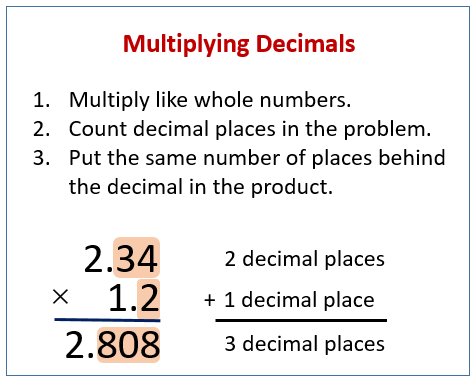
Multiplication and division of decimals were the topics for today. We also discussed some of the properties of multiplication. The properties of equality are a set of rules that allow us to perform operations on equations without changing the truth of the equation.Main Ideas:

Vocabulary:
identity property of equality, zero property, commutative property of multiplication, associative property of multiplicationSections Covered in Textbook:
1-3: Multiplying and Dividing Decimals (pages 17-22)
Resources & Tutorials:
1) How do you multiply decimals?Monday, August 30, 2021
Adding and Subtracting Decimals
Topics for Today:
We are getting back into the swing of things, and setting up classroom routines. Today we did a bit of review of adding and subtracting decimals.**Adding/Subtracting Decimal Numbers MAIN IDEA***
--> When adding or subtracting decimals, always line up the decimal points!
We also did a brief review of subtracting decimals using regrouping, as well as bringing in zeroes (called annexing) to make sure our numbers line up. We also discussed a few of the properties of equality.
Vocabulary:
identity property of addition, commutative property of addition, associative property of additionSections Covered in Textbook:
1-2: Adding and Subtracting Decimals (pages 11-15)
Resources & Tutorials:
1) How do you add decimals?2) How do you subtract decimals?
Friday, August 27, 2021
Using Estimation Strategies
Topics for Today:
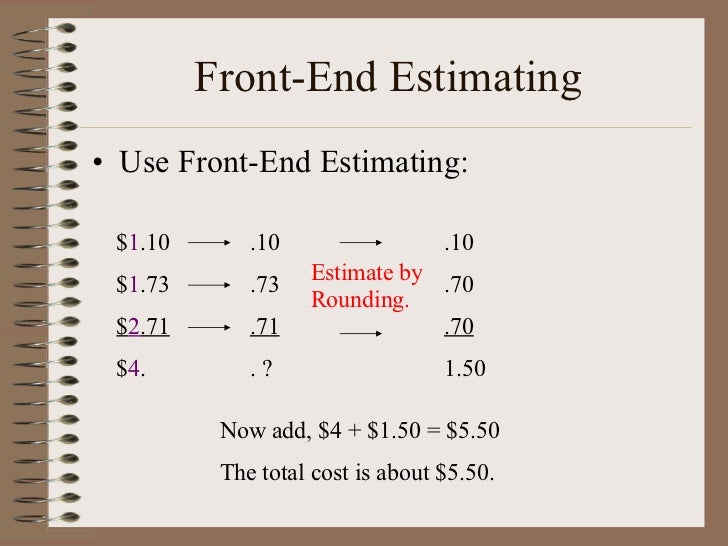
Today we discussed some strategies for estimating the answers to numeric expressions. Students were asked to consider both how to estimate as well as the reasons why we use estimation. We will spend a lot of discussion time this school year on number sense, and determining if our solutions to problems make sense.
Vocabulary:
Sections Covered in Textbook:
1-1: Using Estimation Strategies (pages 5 - 9)
Resources & Tutorials:
1) How do you use front-end estimation to estimate a sum of several decimals?2) How do you estimate a quotient using compatible numbers?
Wednesday, August 25, 2021
Welcome Back, Students!
Hey Everyone!
I'm looking forward to the start of another amazing year at Field School.Please bookmark this site as it will be your one-stop location for anything you need for Math class this year!
GO FALCONS!