Empowering students to reach their mathematical potential through traditional and fun teaching methods.
Thursday, October 15, 2020
Unit 2 Review - October 15
Review Jeopardy Questions
Tuesday, October 13, 2020
Fractions and Decimals - October 13
Topics for Today:
Today we talked about converting fractions to decimals and vice versa. A fraction is simply a division problem with the denominator serving as the divisor. Any fraction can be converted to a decimal by dividing the denominator into the numerator.Vocabulary:
terminating decimal, repeating decimalSections Covered in Textbook:
3-9: Fractions and Decimals (pages 168-172)
Resources & Tutorials:
1) Convert a fraction to a decimalThursday, September 24, 2020
Divisibility Rules - Sept 24
Topics for Today:
Today we discussed the rules for divisibility. A number is divisible by another if it can be divided by it with no remainder. Knowing divisibility rules helps with simplifying fractions and prime factorization.Vocabulary:
divisibleSections Covered in Textbook:
3-3: Divisibility Tests (pages 141-144)
Resources & Tutorials:
1) What does divisibility mean?Tuesday, September 15, 2020
Multiplying and Dividing Integers - Sept 15th
Topics for Today:
We moved on to multiplying and dividing integers today.
Some basic sign rules for multiplication and division:
+ · + = + + / + = +
+ · - = - + /
- = -
- · + = - - /
+ = -
- · - = + - /
- = +
Stated a different way, when we multiply two integers with the same sign, we get a positive product; when we multiply two integers with different signs, we get a negative. The same rules apply for division. Many students find multiplying and dividing integers to be much easier than adding and subtracting!
Vocabulary:
Sections Covered in Textbook:
1-8: Multiplying and Dividing Integers (pages 45-49)
Resources & Tutorials:
1) How do you multiply and divide numbers with different signs?
2) What are Multiplicative Inverses?
3) What is a reciprocal?
Assignments:
Multiplying and Dividing Integers WorksheetExtras:
Sunday, September 13, 2020
Subtracting Integers - Sept 11th
Topics for Today:
Subtracting integers can be a tricky concept for our younger students, especially those still developing abstract thinking skills. We used two concrete methods today to discuss subtraction of integers. The first important key is to realize that subtraction means to physically take something away. It can be challenging to understand how to take something away that isn't there to begin with. To accomplish subtraction, we used integer chips and number lines to illustrate how subtraction works.Vocabulary:
rule for subtracting integers, subtractionSections Covered in Textbook:
1-7: Adding and Subtracting Integers (pages 39-44)
Resources & Tutorials:
1) How do you add two negative numbers?
2) Rules for Adding Integers
3) How to rewrite a subtraction problem as addition
4) Subtracting Integers Class Notes
Extras:
Thursday, September 10, 2020
Adding Integers - Sept 10th
Topics for Today:
We used integer chip models and rules
to add integers today. We talked
about the inverse property of addition and discovered that additive inverses
are just opposites of each other, and they add to zero. We also discussed how to use a number line to
represent addition problems of both positive and negative integers.

Vocabulary:
additive inverse, inverse property of additionSections Covered in Textbook:
1-7: Adding and Subtracting Integers - Part 1 (pages 39-44)
Resources & Tutorials:
1) How do you add two negative numbers?2) Rules for Adding Integers
3) What is the opposite of a number?
Tuesday, September 8, 2020
Guess and Check Strategy - Sept 8th
Topics for Today:
Today we explored some story problems. Students typically are not excited about story problems until they see and solve enough of them to start recognizing patterns. One of the main focuses of the mathematics program at Field School is to help students organize problems and apply them to patterns we have worked with together.Today we used the guess and check strategy which is very useful especially for students who have not had a thorough Algebra I course. For the guess and check strategy, students take the information from the problem and try combinations until they satisfy the other conditions in a problem. Organizing the guesses into a table keeps the work organized.
Vocabulary:
guess and checkSections Covered in Textbook:
None - this lesson was pulled from other materials
Resources & Tutorials:
1) How to solve an equation by guessing and checking.2) Learn Guess and Check (not a video).
Assignments:
1) Guess and Check Worksheet2) Quiz tomorrow over decimal operations
Extras:
Another Ken Ken PuzzleFriday, September 4, 2020
Comparing and Ordering Integers - Sept 4
Topics for Today:
Absolute value is an important mathematical concept that is applied in many areas. Absolute value is a number's distance from zero. Because we are looking at a distance, we are only concerned about positive values. Absolute value is always positive!We discussed integers today and also defined what number opposites are (additive inverses). Using a number line, we also compared the size of numbers using inequality symbols and analyzed integers to put in the in order from least to greatest.
Vocabulary:
opposites, integers, absolute valueSections Covered in Textbook:
1-6: Comparing and Ordering Integers (pages 34-38)
Resources & Tutorials:
1) What is an integer?2) What does absolute value mean?
Assignments:
1) Comparing and Ordering Integers WorksheetExtras:
Thursday, September 3, 2020
Multiplying and Dividing Decimals - September 3rd
Topics for Today:
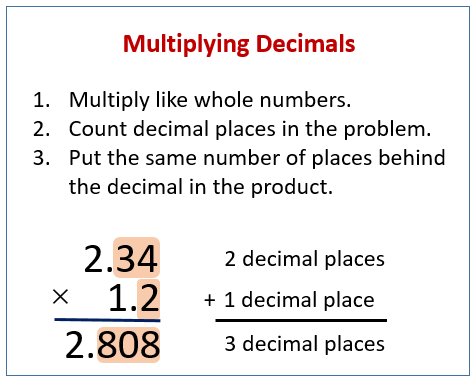
Multiplication and division of decimals were the topics for today. We also discussed some of the properties of multiplication. The properties of equality are a set of rules that allow us to perform operations on equations without changing the truth of the equation.Main Ideas:

Vocabulary:
identity property of equality, zero property, commutative property of multiplication, associative property of multiplicationSections Covered in Textbook:
1-3: Multiplying and Dividing Decimals (pages 17-22)
Resources & Tutorials:
1) How do you multiply decimals?2) How do you divide decimals?
Assignments:
1) Multiplying and Dividing Decimals Worksheet2) Join Google Classroom - code kkor4pp
Extras:
Hearty RootsWednesday, September 2, 2020
Adding and Subtracting Decimals - September 2nd
Topics for Today:
We are getting back into the swing of things, and setting up classroom routines. Today we did a bit of review of adding and subtracting decimals.**Adding/Subtracting Decimal Numbers MAIN IDEA***
--> When adding or subtracting decimals, always line up the decimal points!
We also did a brief review of subtracting decimals using regrouping, as well as bringing in zeroes (called annexing) to make sure our numbers line up. We also discussed a few of the properties of equality.
Vocabulary:
identity property of addition, commutative property of addition, associative property of additionSections Covered in Textbook:
1-2: Adding and Subtracting Decimals (pages 11-15)
Resources & Tutorials:
1) How do you add decimals?2) How do you subtract decimals?
Assignments:
1) Have course syllabus signed by Thursday.2) Adding and Subtracting Decimals Worksheet
Extras:
Find those numbers!Tuesday, September 1, 2020
Using Estimation Strategies - Sept 1st
Topics for Today:
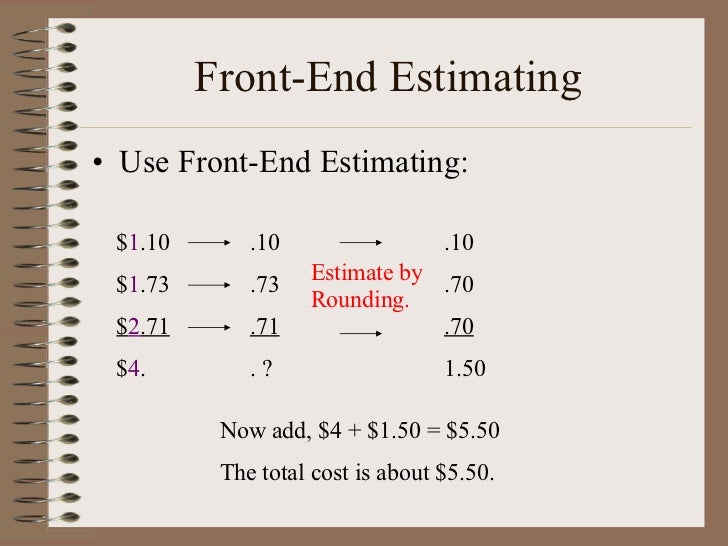
Today we discussed some strategies for estimating the answers to numeric expressions. Students were asked to consider both how to estimate as well as the reasons why we use estimation. We will spend a lot of discussion time this school year on number sense, and determining if our solutions to problems make sense.
Vocabulary:
Sections Covered in Textbook:
1-1: Using Estimation Strategies (pages 5 - 9)
Resources & Tutorials:
1) How do you use front-end estimation to estimate a sum of several decimals?2) How do you estimate a quotient using compatible numbers?
Assignments:
1) Using Estimation Strategies Worksheet2) Get course syllabus signed by Thursday
Extras:
1) Guess It! - Online Estimation Game